





- New
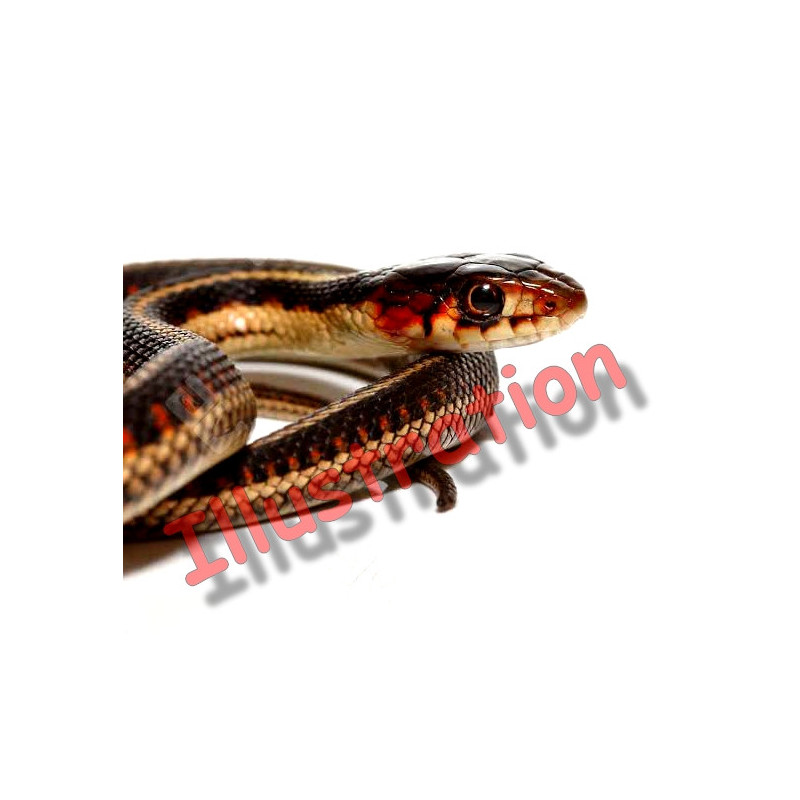
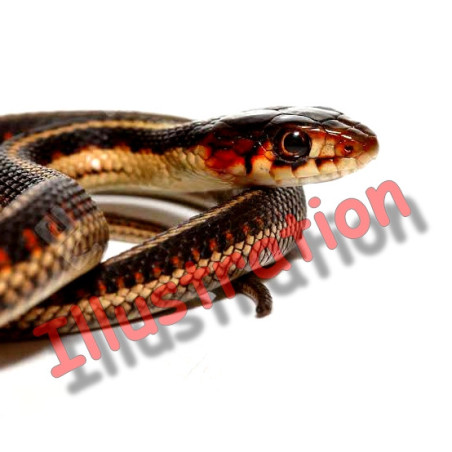
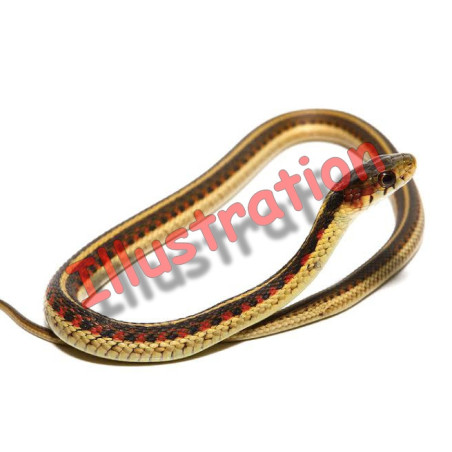


Nom scientifique : Thamnophis sirtalis fitchi
Français : Couleuvre rayée de Fitch
Anglais : Valley Garter Snake
Allemand : Fitch-Strumpfbandnatter
Néerlandais : Fitch-kousenbandslang
 15-day money-back guarantee! (excluding animals)
 Delivery with tracking number; guaranteed breakage-free or 100% money back!
 Deliveries only to Belgium, France, Luxembourg, Hamm (DE) and Houten (NL)
• Newborn (approx. 0 to 3 months): about 24 × 18 × 7 cm, 3-litre Braplast-type box
• Juvenile (approx. 3 to 6 months): minimum 30 × 30 × 30 cm
• Subadult (approx. 6 to 18 months): minimum 45 × 45 × 45 cm, ideally 60 × 45 × 45 cm
• Adult (18 to 24 months and older): minimum 80 × 45 × 45 cm for one adult. For each additional adult, add 20% floor space for each of these snakes.
Note: These dimensions are husbandry recommendations, not absolute biological dimensions. The largest possible floor space should always be the goal. The MINIMUM size of an enclosure is defined according to the size of the snake: snake length = width + depth of the enclosure.
• Type of enclosure: Well-ventilated, escape-proof terrestrial enclosure (openings smaller than 1 mm for newborns!) and long enough to allow a temperature gradient to be established.
• Dimensions: See the recommended dimensions above. A young snake should not be placed in a space that is too large, nor in an environment completely lacking hiding places. Conversely, for adults, the largest possible enclosure is always preferable to provide a genuine activity area.
• Substrate: Lignocel (one of the few wood-based substrates that can pass through the digestive tract without major risks!), natural soil without fertiliser or pesticides, soil/potting mix without additives, absorbent paper,… in a layer 5 to 10 cm deep so that the snake can hide by burrowing under the substrate. One part of the substrate can stay drier while another area offers a slightly more humid microclimate.
• Furnishing: Hiding places (cave, opaque box, bark, a substrate layer deep enough for burrowing,...) and a large water bowl allowing the snake to submerge completely. Optionally, areas of natural or artificial vegetation, low branches, elements allowing movement between different height levels,... Provide several hiding places spread across the different thermal zones, a warm resting area and a cool area
• Note: Thamnophis regularly swallow particles of substrate that stick to their food! It is therefore essential to avoid fine sand, dusty substrates, wood shavings, chemically treated substrates and materials that can easily be swallowed because of their size. Young snakes are particularly active and must be able to find a hiding place quickly. A well-structured enclosure offers plenty of safe areas without hindering movement.
• Daytime ambient temperature: about 22 to 26 °C.
• Hot spot temperature: about 28 to 32 °C
• Night-time temperature: about 18 to 21 °C.
• Type of heating: Thermostat-controlled heat mat covering 1/3 of the floor surface, at one end of the enclosure, and/or heat lamp.
• Temperature gradient: A warm zone must be available at one end of the enclosure while the other end remains clearly cooler, allowing the animal to choose its own body temperature.
• Special feature: Avoid a uniformly high temperature throughout the enclosure. For this subspecies, sources indicate activity temperatures of about 24–30 °C with a locally warmer zone, and lower night-time temperatures.
• Daytime humidity: about 40–60 %, with natural variations depending on the zones of the enclosure.
• Night-time humidity: about 50–70 %, without keeping the substrate constantly soaked.
• Hydration: Permanent access to clean water; the animal can also regularly submerge itself.
• Water: Large, stable container, deep enough for the animal to submerge completely, but easy to get into. Change the water regularly, and immediately if it is soiled.
• Special feature: This species particularly enjoys access to water. However, high humidity is not a substitute for good hydration.
• Ventilation: Effective, permanent ventilation to prevent a stuffy atmosphere, stagnant moisture and the appearance of toxic mould.
• UVB lighting: Low to moderate UVB recommended but not essential, with an exposure zone allowing the animal to choose its level of exposure. UVB is not necessarily an absolute requirement when a properly balanced diet is provided, but it is particularly relevant for this diurnal species.
• Light: LED lighting or fluorescent tube reproducing a bright white light during the day.
• Photoperiod: about 10 to 14 hours of light per day, gradually adjusted to the seasons.
• Newborns and juveniles: Whole live or chopped earthworms (no compost worms!), thawed "pinkie" baby mice/rats served whole or chopped depending on the size of the snake, dead or live fish of suitable sizes or chopped, but above all containing no thiaminase. Examples of fish without thiaminase: trout, salmon, guppy, sand smelt (Atherina boyeri), pond smelt (Hypomesus olidus),.... The diet must be varied and suited to the size of the animal.
• Subadults and adults: Varied diet identical to that of juveniles but made up of whole prey.
• Frequency: Newborns: about every 2–3 days; juveniles: about every 3–5 days; subadults and adults: generally every 5–7 days, to be adjusted to the snake's condition and the type of prey.
• Special feature: Variety is essential. A diet consisting exclusively of fish should be avoided, as some fish contain thiaminase, an enzyme that causes vitamin B1 deficiency. Fish must not make up the staple diet because they do not provide all the necessary nutrients. Rodents and earthworms are considered a good routine staple.
• Supplements: A varied diet based on properly chosen whole prey generally does not require routine supplementation.
• Hydration: Fresh, clean water available at all times in a container large enough to also allow bathing. The water must be changed regularly and whenever it is soiled.
• Danger and safety: Non-venomous species, not dangerous to humans. A bite is still possible, particularly with a stressed animal or at feeding time. These snakes may also release a strong-smelling, unpleasant cloacal secretion when they feel threatened
• Handling technique: Pick up the animal avoiding sudden or quick movements, supporting the body properly, that is, offering the snake at least two points of support (between the fingers, with both hands, …) without ever squeezing the animal's body. Never grab them by the tail.
• Special feature: Young snakes can be particularly quick and nervous. Regular, appropriate handling helps, in the medium term, to calm these animals during handling, but it must remain limited and respect periods of stress, shedding or digestion.
• Hygiene: Wash your hands thoroughly before and after any handling or cleaning of the enclosure. Regularly clean and disinfect soiled equipment.
• In captivity: A winter rest/brumation can be offered from the first year, but it is particularly beneficial to subadults and adults for their good health, especially when the goal is breeding. It reproduces the natural seasonal cycle of this subspecies.
• Temperature: For a true brumation, gradually lower the temperature over a period of 3 to 4 weeks until it reaches 5–8 °C. Then, for a period of 6 to 10 weeks, place the animals in the darkness of an opaque container holding a damp but not soaked substrate. Finally, once these 6 to 10 weeks have passed, gradually raise the temperature over a period of 3 to 4 weeks until it reaches 22–26 °C. Brumation must never be applied to a sick, emaciated or insufficiently prepared animal.
• Photoperiod: Over the 3 to 4 week period, gradually reduce the photoperiod until the light is completely off for 6 to 10 weeks, with no natural daylight.
• Feeding: Stop feeding completely two weeks before the gradual temperature drop to give the digestive system time to empty completely. Fresh water must always be available.
• Container: Opaque, escape-proof box with a few holes for ventilation. 10–30 cm of slightly damp substrate, small water bowl because the animals may drink during the winter rest.
• Breeding: The seasonal cycle and the cold winter period play an important role in breeding. Mating generally takes place in spring, just after hibernation ends, and births then occur in late summer.
• CITES status: This species is not listed in CITES.
• Documents provided with the purchased animal: invoice stating the species name and, where applicable, its genetic mutations, the origin of the animal (captive-bred in the EU), the sex of the animal or the fact that it is sold unsexed, and the birth period. None of these animals is sold identified by a microchip, with a CITES document or accompanied by photos.
• Documents required for purchase: NONE. In accordance with European and Flemish Belgian legislation, we are authorised to sell and deliver legally, to anyone aged 18 or over, all the animals legally offered in our online shop. No particular administrative procedure, specific document or prior authorisation is required from our customers, regardless of the legislation in force in their country of residence.
• Delivery: Home delivery possible in Belgium, France and Luxembourg only! Delivery possible at certain reptile fairs: Hamm (Germany), Houten (Netherlands) and Insectopy (Belgium). Delivery IMPOSSIBLE to other countries.
• Responsibility: the customer is solely responsible for the legality of keeping the animal and for the administrative procedures to be completed in their own country.
Specific References
No customer reviews for the moment.
Nom scientifique : Thamnophis sirtalis fitchi
Français : Couleuvre rayée de Fitch
Anglais : Valley Garter Snake
Allemand : Fitch-Strumpfbandnatter
Néerlandais : Fitch-kousenbandslang