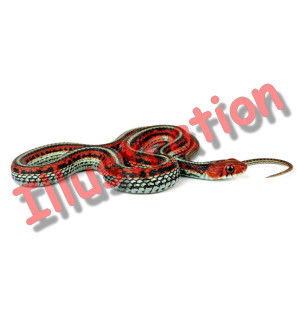
Thamnophis sirtalis tetrataenia
✅ Species Information
• General information: Thamnophis sirtalis tetrataenia, commonly known as the San Francisco Garter Snake, is a subspecies of Thamnophis sirtalis endemic to California. It is particularly renowned for its striking coloration and is one of the most distinctive snakes in North America. It is listed as endangered in both the United States and California.
• Distinctive features: This subspecies has an extremely restricted range, and its remaining populations are now fragmented and isolated. It is closely associated with freshwater wetlands and the grasslands bordering them. It is live-bearing: embryos develop inside the female, and the young are born alive, usually during July and August.
• Geographical distribution: It is found exclusively on the San Francisco Peninsula in California. Its historical range extended from the boundary between San Francisco and San Mateo Counties southwards along the foothills of the Santa Cruz Mountains to northern Santa Cruz County, particularly around the Año Nuevo area. Present-day populations are localized and isolated.
• Natural habitat: It inhabits freshwater marshes, ponds, pools, canals and slow-moving streams, usually surrounded by dense vegetation. Nearby grasslands are also essential for thermoregulation, foraging, reproduction and overwintering. During colder periods, it may shelter in rodent burrows or beneath rocks.
• Behaviour: Diurnal, active and an excellent swimmer, this snake hunts both in water and along the banks. Its diet consists mainly of amphibians, particularly Pacific tree frogs (Pseudacris regilla) and California red-legged frogs (Rana draytonii). It also eats newts, toads, small fish and occasionally other small prey. When disturbed, it generally attempts to escape into the water or hide among vegetation.
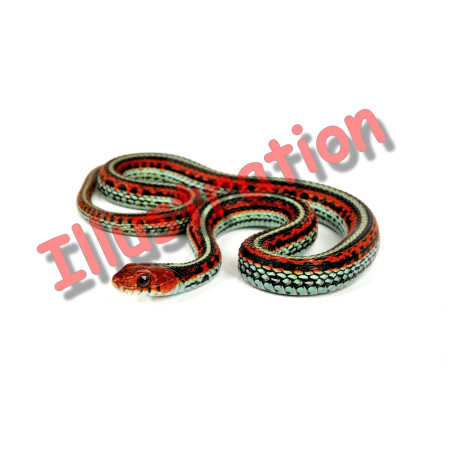
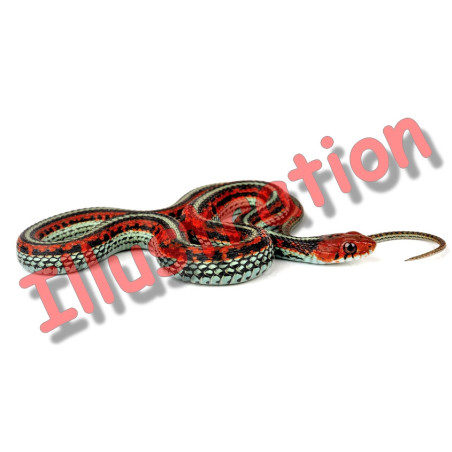
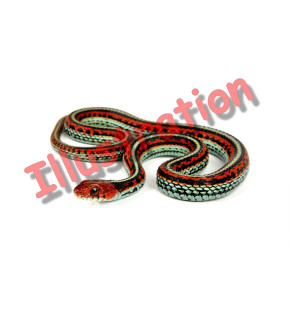
• Morphological characteristics: Its body is slender and displays a particularly striking colour pattern. The background colour is generally black or very dark. A broad yellowish-green to turquoise stripe runs along the back, bordered by black lines. Two red to orange stripes run along the sides, also edged in black. The top of the head is often reddish-orange, while the belly is blue-green or turquoise. Colour intensity and shades may vary between individuals.
• Sexual dimorphism: Females are considerably larger and heavier than males. Males have a slimmer build and are generally shorter. The difference in body size between the sexes is particularly pronounced in this subspecies.
• Size: Females generally reach a total length of around 100 cm and may grow to approximately 120 cm. Males are smaller, reaching an average length of about 83% of that of females.
• Sexual maturity: Sexual maturity is generally reached at around 2 years of age, although this may vary depending on sex, growth rate and environmental conditions.
• Life expectancy: Its exact lifespan in the wild remains poorly known. A lifespan of approximately 8 to 15 years is reported in captivity, although available data are limited.