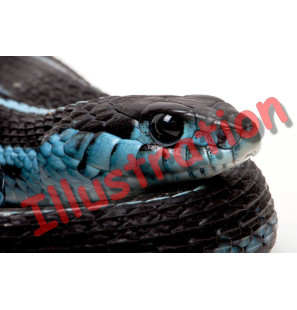
Thamnophis sirtalis pickeringii
✅ Species information
• General information: Thamnophis sirtalis pickeringii, commonly known as the Puget Sound Garter Snake, is a subspecies of the Common Garter Snake belonging to the family Colubridae. It is particularly notable for its strong colour contrast, usually featuring a dark body with bright yellow to turquoise longitudinal stripes. It is mainly diurnal and semi-aquatic.
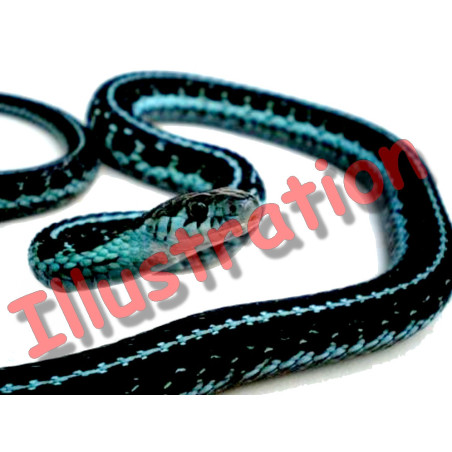
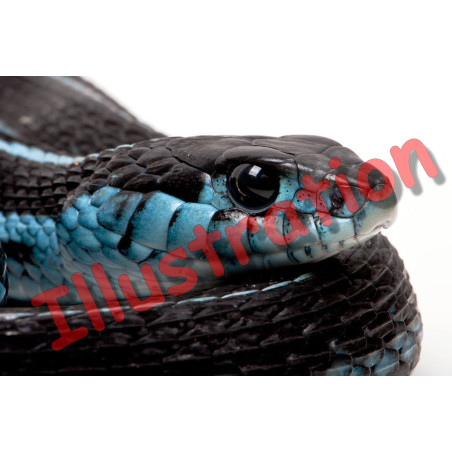
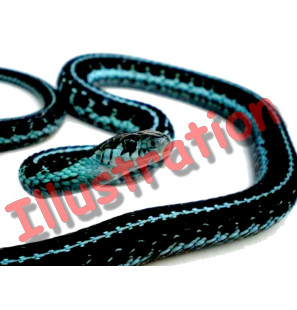
• Particularities: This subspecies is distinguished by its often highly contrasting colouration. The dorsal and lateral stripes may be bright yellow, blue-green or turquoise. Some populations also have small reddish markings on the flanks. The underside ranges from turquoise to black.
• Geographical distribution: It is native to northwestern North America. Its range mainly includes the Puget Trough lowlands in Washington State and southwestern British Columbia, particularly Vancouver Island. Its distribution is considerably more restricted than that of the nominal subspecies.
• Natural habitat: It inhabits wet meadows, marshes, open woodland, forest edges and the banks of ponds, lakes and streams. It favours environments offering dense vegetation for shelter alongside open, sunny areas for thermoregulation.
• Behaviour: Mainly diurnal, this garter snake is active and agile. It moves both on land and through water and is an excellent swimmer. It regularly seeks sunny spots to warm itself. When disturbed, it retreats into vegetation or beneath suitable cover. During cold periods, it may overwinter communally in sheltered locations.
• Morphological characteristics: The body is relatively slender, with a head that is not clearly distinct from the neck. The dorsal scales are keeled. The ground colour is usually black or very dark brown. A light longitudinal stripe runs along the centre of the back, with two additional stripes along the sides. These stripes are generally bright yellow, turquoise or blue-green. The underside may be turquoise, bluish or almost entirely black. Small red markings may occasionally occur on the flanks.
• Sexual dimorphism: Females are generally larger and more robust than males. Males remain smaller and have proportionally longer tails. Differences in body shape are usually more apparent in adults.
• Size: Adults generally measure around 50 to 90 cm. Larger individuals are possible. These figures are indicative, as measurements specifically relating to this subspecies are less abundant than those available for Thamnophis sirtalis as a whole.
• Sexual maturity: Both males and females generally reach sexual maturity at around 1 to 2 years of age, depending on growth and environmental conditions. Specific data for this subspecies remain limited.
• Life expectancy: Specific information about this subspecies is poorly documented. In captivity, a lifespan of approximately 6 to 10 years is a reasonable indicative estimate. Some individuals may live longer with appropriate care.