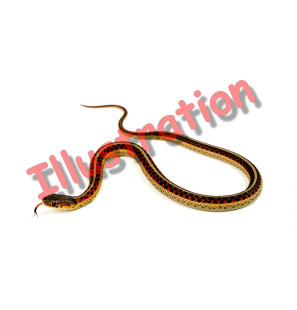
Thamnophis sirtalis parietalis
✅ Species information
• General information: Thamnophis sirtalis parietalis is a subspecies of Thamnophis sirtalis, commonly known as the Red-sided Garter Snake. It is an active, robust North American snake that is primarily terrestrial and particularly well adapted to temperate and continental climates. It is viviparous and gives birth to fully independent young.
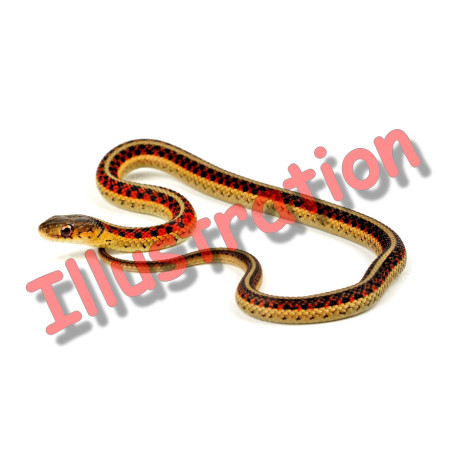
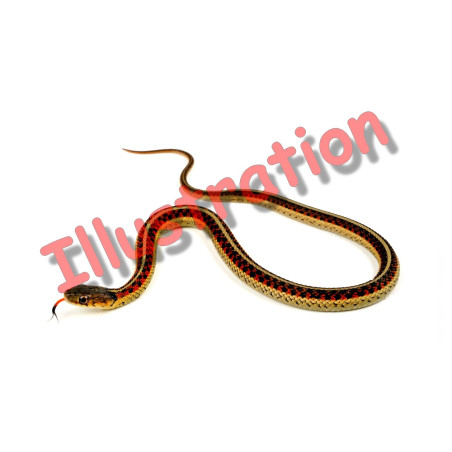
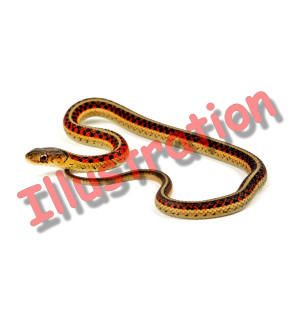
• Special characteristics: This subspecies is distinguished by the characteristic red or orange markings along its flanks, located between the dorsal scales and the light longitudinal stripes. These lateral markings generally contrast with a dark, black or brown dorsal background. Their intensity and extent vary depending on the individual and the population.
• Geographical distribution: Central and northern United States, particularly the Great Plains, as well as southern and central Canada, especially the Prairie Provinces of Manitoba, Saskatchewan and Alberta. Its distribution also extends into certain northern regions of the United States and neighbouring areas of Canada.
• Natural habitat: A wide variety of habitats, including prairies, grasslands, forest edges, agricultural areas, marshes, ditches, ponds and stream banks. It particularly favours wetlands and grasslands located near water. In colder regions, it uses communal hibernation sites, often consisting of rock crevices or deep underground cavities.
• Behaviour: A mainly diurnal, active and relatively curious species. It regularly explores its surroundings, moves primarily along the ground and can climb at low heights. It enjoys being close to water and readily swims. This subspecies is particularly known for sometimes forming very large aggregations when emerging from hibernation and during the spring breeding season. It can release foul-smelling cloacal secretions when stressed.
• Distinctive morphological features: Relatively slender body, head slightly wider than the neck and strongly keeled dorsal scales. Three light longitudinal stripes are generally visible: one central dorsal stripe and two lateral stripes. The flanks display characteristic red or orange markings, usually located between the lateral stripes and the rows of dorsal scales. The overall coloration ranges from brown to black, with varying degrees of contrast depending on the individual.
• Sexual dimorphism: Females are generally larger and more robust than males. Males are smaller and have proportionally longer tails.
• Size: Generally around 45 to 75 cm in adulthood, with some individuals approaching or exceeding 1 m. Females generally reach larger sizes than males.
• Sexual maturity: Males generally reach sexual maturity at around 1.5 years, while females reach maturity at around 2 years. However, physiological maturity does not necessarily mean that a female should be bred at this age: her size, weight and body condition must also be sufficient.
• Life expectancy: Generally 10 to 15 years in captivity with good husbandry conditions; a longer lifespan is possible in some cases.