Thamnophis sirtalis sirtalis flame
✅ Information about the Flame morph
• General information: Thamnophis sirtalis sirtalis Flame is a colour morph selectively bred in captivity from the nominate subspecies of the Common Garter Snake (Eastern Garter Snake). The term “Flame” refers to a selectively bred form displaying particularly intense, warm colours. It is neither a separate species nor a taxonomically recognised subspecies.
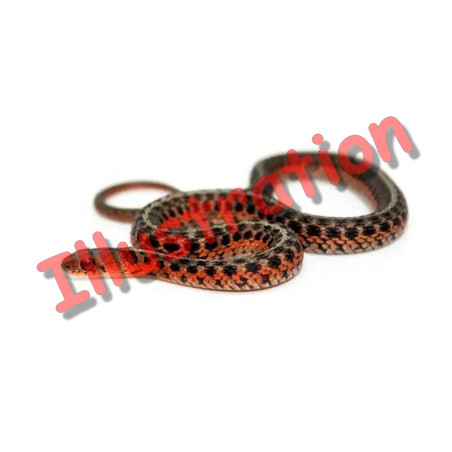
• Special features: This morph is characterised by enhanced red, orange or copper tones, particularly along the flanks and sometimes within the longitudinal stripes. Its exact appearance depends on the breeding line and selection process. As Flame is not a genetically standardised designation, its use may vary between commercial breeding lines.
• Geographical distribution: This colour morph was developed through selective breeding in captivity and has no distinct natural geographical range. The nominate subspecies Thamnophis sirtalis sirtalis is native to eastern North America, from southeastern Canada to the northeastern and eastern United States.
• Natural habitat: The Flame morph has no separate natural habitat. In the wild, the nominate subspecies inhabits moist grasslands, open woodland, marshes and the banks of ponds, lakes and streams. It can also adapt to certain agricultural and suburban environments.
• Behaviour: Its behaviour is comparable to that of the normal-coloured form. It is mainly diurnal, active when temperatures are favourable and frequently basks in the sun. It is a good swimmer and quickly retreats into vegetation or water when disturbed. Its diet includes earthworms, amphibians, fish and various small invertebrates.
• Morphological characteristics: The background colour is generally dark, ranging from black to brown or olive, with three characteristic longitudinal stripes. In the Flame morph, warm colours are particularly pronounced: the stripes and lateral markings may display bright red, orange, copper or yellow-orange tones. Colour intensity and distribution vary between individuals and breeding lines.
• Sexual dimorphism: Females are generally larger and heavier-bodied than males. Males have a more slender build and a proportionally longer tail.
• Size: Adult size is comparable to that of the normal-coloured form. Individuals generally measure approximately 45 to 66 cm, although some specimens can exceed 1 m. Females are usually larger than males.
• Sexual maturity: Males generally reach sexual maturity at around 1 to 2 years of age, while females usually mature at approximately 2 to 3 years. Development depends on factors such as growth and husbandry conditions.
• Life expectancy: Life expectancy is comparable to that of the nominate subspecies. Approximately 6 to 10 years in captivity is a cautious estimate, although some individuals may live longer.