

€61.98Price
- New
- New
Thamnophis marcianus
Nom scientifique : Thamnophis marcianus Français : Couleuvre à damier Anglais : Checkered Garter Snake Allemand : Karierte Strumpfbandnatter Néerlandais : Geblokte Kousebandslang
€61.98Price


• General information: Thamnophis marcianus, commonly known as the Checkered Garter Snake, is a North American snake belonging to the family Natricidae. It is distinguished by its characteristic checkerboard pattern of small dark spots along the sides of its body. It is primarily terrestrial but closely associated with aquatic habitats.
• Special features: Unlike some other species of the genus Thamnophis, which have continuous lateral stripes, this species displays a distinctive pattern of alternating dark spots. It is viviparous, giving birth to fully developed young.
• Geographical distribution: Its range extends from the southwestern United States, particularly California, Arizona and New Mexico, through Mexico. Additional, sometimes isolated populations occur in Guatemala, Belize, Honduras, Nicaragua and Costa Rica.
• Natural habitat: This species is mainly found around ponds, lakes, rivers, streams, marshes, swamps and irrigation canals. It also inhabits drier environments, including grasslands, semi-arid areas and savannas. In arid regions, access to water is an important feature of its habitat.
• Behaviour: It is generally active during the day when temperatures are favourable, although it may become crepuscular or nocturnal in particularly hot regions. It swims readily and forages both in water and on land. Its diet includes fish, amphibians, tadpoles, small lizards and various invertebrates.
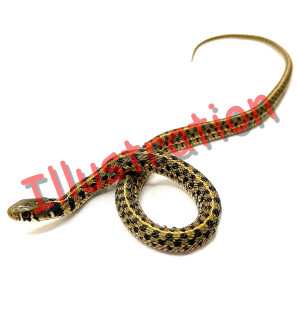
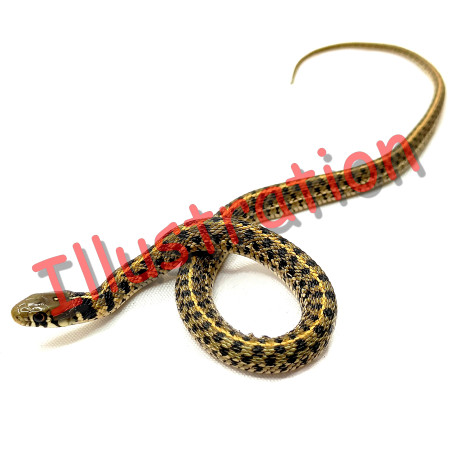
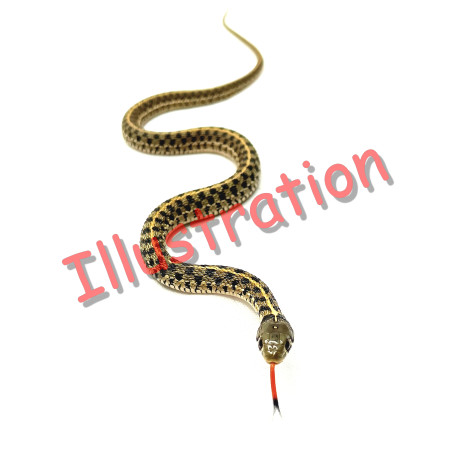
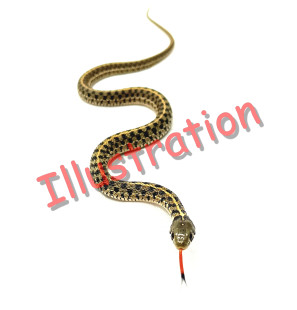
• Morphological characteristics: The background colour varies from grey to brown, olive or tan. A pale, usually yellowish to orange dorsal stripe runs along the back. Two alternating rows of dark spots are present along the flanks, creating the characteristic checkerboard pattern. The underside is generally whitish, cream or slightly bluish. The dorsal scales are strongly keeled.
• Sexual dimorphism: Females are generally longer and noticeably heavier-bodied than males. Males remain more slender and usually reach a smaller adult size.
• Size: Adults generally measure between 45 and 80 cm in total length, although some individuals can exceed 1 m. Females are usually larger than males.
• Sexual maturity: Males generally reach sexual maturity at around one and a half years of age, while females usually mature at approximately two years.
• Life expectancy: The documented lifespan is approximately 7 years in the wild and can reach around 10 years in captivity.
2 products